Pages

Showing posts with label Science. Show all posts

Tuesday, 7 December 2021

Making Hokey Pokey

 Aim I want to find out how to make hokey pokey.


Research:

How to make hokey pokey

Hokey Pokey


Method:

Equipment

  • Sugar
  • Baking soda
  • Golden syrup
  • tablespoon
  • saucepan
  • cookie cutter
  • Bunsen burner
  • Safety Goggles (Option)
  • Baking paper
  • Tripod
instructions:

  1. Get your equipment.
  2. Wash your hands.
  3. Set up the bunsen burner.
  4. Put the saucepan on the tripod over the bunsen burner.
  5. Light the bunsen burner.
  6. add 5 tablespoons of sugar to the pot.
  7. add 2 tablespoons of golden syrup to the pot.
  8. Melt and mix.
  9. Turn off the gas and add one tablespoon of baking soda and mix.
  10. scrape the hokey pokey onto the baking paper.
  11. Let it cool for a minute.
  12. Press a cookie cutter into the hokey pokey.
Results

Discussion:

Tuesday, 30 November 2021

Making Ginger Beer

 Aim: I want to know how to brew ginger beer.


Research:

Fermentation

How to brew alcohol

How to brew ginger beer

Method:

Equipment:

  • Ginger  (source of sugar)
  • Warm water
  • Yeast
  • Cup
  • Spoon


Instructions:

  1. Get the equipment.
  2. Put 1 tablespoon of ginger in the cup.
  3. Half fill the cup with warm water.
  4. add 1 teaspoon of yeast.
  5. Mix it all together.
  6. Leave it to ferment for one week.
  7. After one week, taste it.
Results:
Taste: It lost its sweetness and smells like ginger, the tang was like alcohol, in conclusion, it tasted bad.

Discussion:

What is fermentation: Fermentation is from yeast eating sugar which releases Carbon dioxide and alcohol.
What is the difference between whiskey vodka wine, beer: Whiskey (Grain), Wine (Grapes), Vodka, (Potato), Beer (Hops).


Thursday, 18 November 2021

Red Cabbage Indicator

 Aim: I want to find out how red cabbage can tell if a liquid is an acid or a base.


Research:

Method:

Equipment:

  • Red Cabbage
  • Large Beaker
  •  Acid (Hydrochloric Acid)
  •  Base (Sodium Hydroxide)
  • Eyedropper
  • Test Tube (6)
  • Warm Water

Instructions:
  1.  Wash your hands.
  2.  Get your equipment.
  3. Put warm water in the beaker.
  4. Rip red cabbage into very small pieces.
  5. put the red cabbage into the beaker.
  6. Mix.
  7. fill eyedropper with the red cabbage water and add three drops into each test tube.
  8.  The liquid has to be below half.
  9. Add some base or acid and try to make different colors.
Photos Or Videos of Experiment.
I didn't get any videos because I had to leave early so I will add an internet photo.


Red Cabbage Indicator Colors : Chemistry Experiment for Kids to do at Home  - YouTube

Discussion:
What is an acid and a base?
An acid is a contributing product containing hydrogen ions. Now the solution contains more hydrogen ions than hydroxide ions. That form of solution is acidic. A foundation is a material capable of consuming hydrogen ions. As a base is dissolved in water the equilibrium between hydrogen ions and hydroxide ions changes in the opposite direction.
What do chemical indicators do?
chemical indicator, any substance that gives a visible sign, usually by a color change, of the presence or absence of a threshold concentration of a chemical species, such as an acid or an alkali in a solution. The common application of indicators is the detection of endpoints of titrations.


Thursday, 11 November 2021

Making Sherbet

Aim: I want to find out how to make Sherbet.


Research:


Method:

Equipment:

  • Citric Acid
  • Raro Powder
  • Baking Soda
  • Plate
  • Popsicle Stick

Instructions:

  1. Wash your hands
  2. Get Equipment
  3. Put powders on the plate
  4. 20% Citric Acid, 30% Baking Soda, 50% Raro Powder into one area.
  5. Taste the Sherbet.
  6. If there is too much baking soda, add more citric acid.
  7. If there is too much citric acid, add more baking powder.
  8. If it doesn't taste good, enhance it with Raro powder
  9. (Option) Let your friend taste it.
  10. (Option) Keep it, Probably don't keep it for too long.
Results:
I didn't get a photo so I will explain how mine tasted like.
It tasted super sour and super sweet. 🤩🤩🤩

Discussion:

Why did the sherbet not foam on the paper but it did in your mouth?
Because it was dry.

What was the chemical reaction of the sherbet?
The chemical reaction creates a fizzing feeling in your mouth because of your liquid which was your saliva.
What type of chemical reaction is this?
A neutralisation reaction.


Thursday, 4 November 2021

Blind Taste Test

 Aim: I want to find out if the food tastes different when you can't see or smell.

Research:


Method:

Equipment:

  • Food
  • Popsicle stick
  • Blindfold/Mask. The easy way to make a blindfold is to get glasses and a paper towel
Instructions:
  1. Get your equipment
  2. Wash your hands
  3. Put on your blindfold
  4. Pinch your nose
  5. Get your food and eat it.
  6. Unblock your nose.

Results:

mysteryFirst TasteLast TasteFood Guess
Sweet middlesweet with soursugar
Salty Front Tonguecrunchysalt
Bitter Back TongueSweet And fruitybaking powder
Sour side tongueYummycitric acid
Hard then softpickle
crunchyraw potato
Hard then softapple
Pear
Marshmellow
burger ring
lolly


Discussion:

How do you taste food:
The taste buds pick up clues about how food tastes and send messages about it to your brain along special wires called nerves. To taste something properly, you need to chew food into small pieces and have a lot of drool, or saliva. This helps the flavor molecules (also known as “tastants”) reach your taste buds.
What are the different taste buds of our tongue: Taste buds contain the taste receptor cells, which are also known as gustatory cells. The taste receptors are located around the small structures known as papillae found on the upper surface of the tongue, soft palate, upper esophagus, cheek, and epiglottis.
Does smell affect your taste:
Our sense of smell is responsible for about 80% of what we taste. Without our sense of smell, our sense of taste is limited to only five distinct sensations: sweet, salty, sour, bitter, and the newly discovered “umami” or savory sensation. All other flavors that we experience come from the smell.


Thursday, 28 October 2021

Eating Hot Chilli

 Aim: I want to find how long to get rid of the chili burning off my tongue. (0seconds)


Research:


Method:

Equipment:

  • Carolina Reaper Hotsauce
  • Popsicle Stick
  • Milk
  • Coca-cola
  • Water
  • Timer
  • Cup
Instructions:

  1. Get your equipment.
  2. Scoop some chili onto your stick.
  3.  Start the timer and eat the chili.
  4. Stop the timer after 4 minutes.
  5. Rate how hot your mouth is.
  6. Do Experiment again but drink water after 2 minutes.
  7. Do the experiment again but drink Coca-cola after 2 minutes.
  8. Do experiment again but drink milk after 2 minutes.
Results:
these results are serious
First one without water 1/10
the second one with water 0/10
the third one with coke 0/10
fourth one with milk 0/10


Discussion:

Why does chili burn your mouth? 
1. because of something called capsaicin which is measured in Scoville.
2. chili doesn't only burn your mouth, it can burn your eye.
Why did the milk help?
3. because it's cold.


Thursday, 21 October 2021

Gummy Bear Osmosis

Aim: I want to to find out what happens to Gummy Bears when left in liquids.

Method: Equipment

  • Gummy Bears
  • Liquids - Water, Salt Water, Sugar Water, and sour water.
  • Electronic Scale
  • 4x Petri Dishes
  • Marker Pen

Instructions
  1.  Get Equipment 
  2.  Write your name and condition on the petri dish, Weigh your gummy bear and write down the weight of it.
  3. Weigh Each Gummy Bear.
  4. Add each liquid onto each Petri dish.
  5. Put in a safe area.
  6. Wait 2 days
  7. Taste test. (Probably won't taste good)
This work won't be accurate because this was supposed to be done in term 2 but we didn't have the time. (Probably don't try it)

Tuesday, 19 October 2021

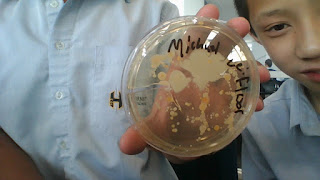
Bacteria Around our School

Aim:

 I want to find out what type of bacteria could be around our school.

Research:

Bacteria

Video about it.
Funny video

Method:

Equipment:
  • Cue tips/Cotton Buds
  • Agar plates
  • Marker Pen
  • Sellotape
Instructions
  1. Get equipment. (Don't open the Agar plate. Open it when you're about to swab it.)
  2. Wash your hands and dry your hands.
  3. Use a marker pen to write your name and location on the lid.
  4. Wet the Cue tip/Cotton bud and swab the surface.
  5. Gently swab the agar plates 3 zig-zags horizontally and vertically to each end.
  6. Tape around the edges of the agar plate.
  7. Put the agar plate in an incubator overnight.
  8. Observe the plate the next day.
  9. Do not open
  10. Throw away the Agar plates.
  11. Pattern:


Bacteria colors and what it means:

White = Poo bacteria (E.coli)
Yellow = Throat infection (Streptococci)
Pink = Food Poisoning (Salmonella)
Red= Brain Infection (Meningitis)

Wednesday, 7 July 2021

Measuring Mentos and Coke

Aim: I want to find out how many bubbles are made when mentos is dropped in coke


Method:

Equipment:

  • Coke, Coke Zero, Sprite
  • Mentos (Mint)
  • Measuring Cylinder (100ml and 10ml)
  • Safety Glasses
  • Liquid Soap/Detergent
  • Small beaker

Instructions:

  1. Get your equipment.
  2. Pour 20mls of coke/coke zero/sprite  into 100ml measuring cylinder
  3. Add 5mls of detergent/liquid soap to the 10ml measuring cylinder
  4.  use the 10ml measuring cylinder and add 5mls to the 100ml measuring cylinder.
  5. Put mentos into 100ml measuring cylinder
My groups results.
CokeCoke zeroSprite
Height of Bubbles504570

Conclusions: I found out that Sprite is the one that goes the highest.

Tuesday, 29 June 2021

Milk Plastic (Casein)

  Aim: I want to find out how you could turn milk into plastic


Method:


Materials:

  • Stove, Oven or Microwave
  • Measuring Cup
  • Measuring Spoon (tsp.)
  • Milk (1 cup)
  • Pot or Microwaveable Container
  • White Vinegar
  • Paper towels
  • Spoon
  • Mug

How to do

  1. Get Equipment.
  2. Pour 1 cup of milk into a pot or microwaveable container.
  3. Heat the milk in the microwave or on the stove until it's steaming.
  4. Add 4 teaspoons of white vinegar to mug.
  5. Add the hot milk to the mug with white vinegar.
  6. Stir the mixture with the spoon.
  7. Stack 4 layers of paper towels on a surface that is safe to get damp.
  8. Scoop out the curds with a spoon and place them on the paper towels.
  9. Fold the paper towels over the curds and press down to absorb excess liquid.
  10. Knead all the curds together into balls of dough.
  11. Color, shape or mold the dough as you like.

Definitions of some of the words

Curd: a soft, white substance formed when milk coagulates, used as the basis for cheese.

Damp: slightly wet.

Container: an object for holding or transporting something.

Mold: a distinctive and typical style, form, or character.


What is casein and what is it used for?

  1. the main protein present in milk and cheese. It is used in processed foods and in adhesives, paints, and other industrial products. It can be used for before bed to help recover and reduce muscle breakdown when they sleep. It has also been found to increase muscle growth.



Wednesday, 23 June 2021

Edible Slime

Aim: I want to fond out how to make edible slime.


Method:

Equipment:

  • Marshmallows
  • Popsicle Stick
  • Cup
  • Microwave
  • Icing sugar
  • Vegetable Oil
Instructions
  1. Get equipment
  2. Put marshmallows in the cup
  3. microwave the marshmallows for 10 seconds, low heat.
  4. Put icing sugar in it and vegetable oil if you want.
  5. Stir the marshmallows with the Popsicle stick.
  6. Eat
How To Make Edible Marshmallow Slime | Little Bins for Little Hands
What does it feel like.It felt ductile (able to be deformed without losing toughness; pliable, not brittle.)


Tuesday, 1 June 2021

Scientific Equipment

1. Beaker = A beaker is a science equipment that is used for carrying liquids.

 100ml Low Form Beaker Measuring Glass Beaker Lab Borosilicate Glassware  Chemistry Learning Stationery Laboratory Supplies|Beaker| - AliExpress

2. Conical flask

Flask Conical B24 Top | Vintessential Laboratories

3. Spatula = holding solid stuff.

Stainless Steel Spatula | Home Science Tools

4. Funnel = an item that is wide at the top and small at the bottom.

Small Glass Funnel for Home & School Science Experiements (Short Stem)

5. Test tube

Test tube Medium 125 x 16mm Rimless - Science Equipment & Glassware - The  Science Shop

6. scissor tongs = scissor tongs are used for picking test tubes or other equipment that could be hot.

Crucible Tongs with Bow Stainless Steel 20cm - MTA Catalogue

7. test tube tongs

Test Tube Clamp / Tongs | Home Science Tools

8. gauze mat

Gauze Mat With Ceramic Centre | OfficeMax NZ

9. tripod

Tripod for Spirit Burner - Science Equipment & Glassware - The Science Shop

10. measuring cylinder = for measuring an accurate amount of liquid.

Measuring Cylinders - DutchChems

11. evaporating basin

Porcelain Evaporating Basin 60ml | OfficeMax NZ

12. Thermometer

Thermometers - Science

13. 

test tube tongs

Test Tube Clamp / Tongs | Home Science Tools

14. Fume cupboard scalpel.

Fume Cupboards for Science: Re - circulatory versus extracted to atmosphere  - Council of British International Schools

15. Boss head clamp

Lab Stands Boss Head Clamps Cross Holder Laboratory Metal Grip Supports  Science Work Too|boss head clamp|laboratory standlab clamp holder -  AliExpress

16. Retort stand

40cm Laboratory Retort Stand Full Set With Clamp Iron Support HTSTAR Lab  Equipment | Laboratory Apparatus,Science Lab Equipment,Teaching  Materials,Lab Supplies Manufacturer,Supplier & Exporter - http://www. laboratory-apparatus.com

17. Burette Pipette

EISCO Borosilicate Glass Burette, with PTFE Stopcock, 50mL Capacity, 0 —  Eisco Labs

18. Volumetric flask

Volumetric flask - Wikipedia

19. Mortar/Pestle = is for preparing substances by crushing and grinding materials with the tool.

Mortar and pestle - Wikipedia